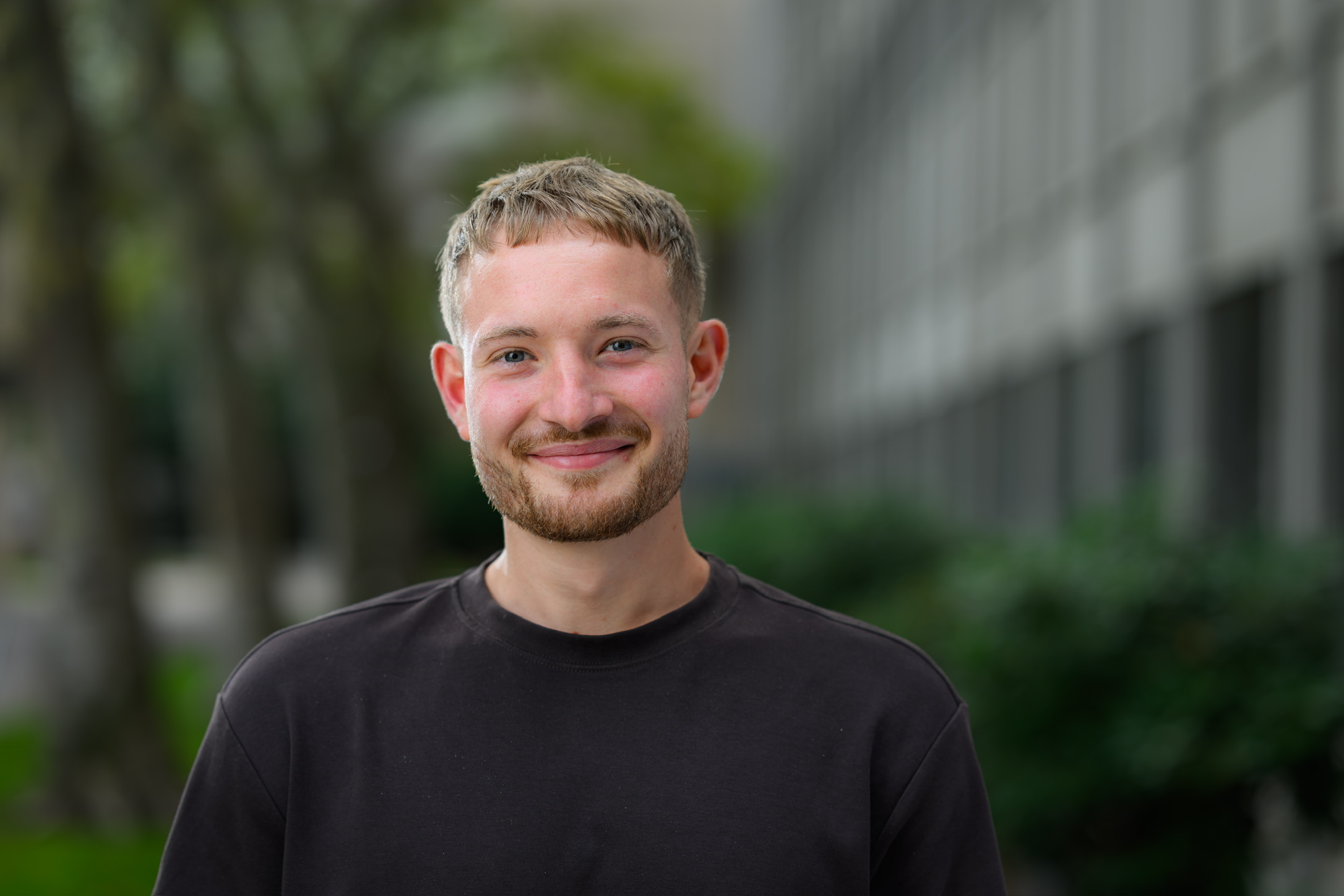
Samir
Darouich
PhD researcher in AI for science
University of Stuttgart
I build generative AI that predicts the 3D shapes of molecules, from stable structures to the short-lived states they pass through when they react.
About
Hi, I'm Samir, a PhD researcher at the University of Stuttgart working on machine learning for chemistry. I develop generative models, mostly based on flow matching and diffusion, that predict the three-dimensional structures of molecules, such as stable conformers and the transition states of reactions. Two directions I'm particularly excited about are one-shot methods, which generate a structure in a single step instead of many small ones, and physically inspired generative models, which learn from the potential energy surface itself rather than from atomic coordinates alone.
I came to machine learning from chemical engineering, where I started out simulating molecules and materials with molecular dynamics and developing force fields. During an internship and working-student position at BASF, I worked with Ratan Mishra on molecular modelling for cement chemistry and corrosion protection. My first real contact with machine learning came when I used it to parameterise force fields from scarce experimental data. Moving from engineering into AI meant learning a lot from scratch, and honestly, that's still the part I enjoy most.
My PhD is advised by Mathias Niepert (AI) and Johannes Kästner (theoretical chemistry). Transition states of chemical reactions are my main test case, since they are fleeting, rare in data and expensive to compute. During a research stay in Heather Kulik's group at MIT, I studied how well generative models generalise to chemistry outside their training data, work now published in Nature Computational Science. More recently, I've worked on one-shot generative modelling under symmetries, which will be presented at NeurIPS 2026, and on flow matching that is supervised with the curvature of the potential energy surface.
I expect to finish my PhD in June 2027 and I'm open to R&D roles in AI for science as well as postdoctoral positions. If you're working on related problems, I'd be glad to hear from you.
News
- ElemeNet: Multiscale Molecular Machine Learning with Uncertainty Quantification Across the Periodic Table, a collaboration with the Kulik group at MIT, was published in the Journal of Chemical Information and Modeling.
- New preprint: Curvature-Aware Flow Matching for Molecular Structure Generation, which teaches generative models the curvature of the potential energy surface.
- SymDrift, one-shot generative modelling under symmetries, was accepted at NeurIPS 2026.
- Robust generative transition-state models for unseen chemistry, the work from my MIT research stay, was published in Nature Computational Science.
- Adaptive transition-state refinement with learned equilibrium flows was published in the Journal of Chemical Information and Modeling.
- I started a three-month research stay in Heather Kulik's group at MIT.
Publications
Grouped by field, from my current work in machine learning back to molecular simulation. A full list is on Google Scholar. * equal contribution
Machine learning for chemistry
- Curvature-Aware Flow Matching for Molecular Structure Generation arXiv preprint, 2026
- SymDrift: One-Shot Generative Modeling under Symmetries arXiv preprint, 2026 (accepted at NeurIPS 2026)
- Robust Generative Transition-State Models for Unseen Chemistry Nature Computational Science, 2026
- Adaptive Transition-State Refinement with Learned Equilibrium Flows Journal of Chemical Information and Modeling 66(4), 2154–2165, 2026
- Physics-Based Molecular Fingerprints from Spectral Graph Theory Provide Efficient Geometry-Aware Measures of Chemical Similarity arXiv preprint, 2026
- ElemeNet: Multiscale Molecular Machine Learning with Uncertainty Quantification Across the Periodic Table Journal of Chemical Information and Modeling, 2026
- Generalized DeepONets for Viscosity Prediction Using Learned Entropy Scaling References Digital Discovery 4(12), 3578–3587, 2025
- Physics-Informed Multifidelity Gaussian Process: Modeling the Effect of Water and Temperature on the Viscosity of a Deep Eutectic Solvent Journal of Chemical Information and Modeling 65(8), 3999–4009, 2025
Molecular simulation and materials
- INTERFACE Force Field for Alumina with Validated Bulk Phases and a pH-Resolved Surface Model Database for Electrolyte and Organic Interfaces Chemical Engineering Journal, accepted
- Mechanistic Insights into the Anion-Driven Suppression of the Initial Cement Reaction of Tricalcium Aluminate Journal of the American Ceramic Society 109(1), e70480, 2026
- Understanding Hydration Reactions, Mechanical Properties, Thermal Expansion, and Organic Interfacial Interactions of Calcium Sulfate Hydrates from the Atomic Scale Cement and Concrete Research 189, 107740, 2025
- Influence of Water Content on Thermophysical Properties of Aqueous Glyceline Solutions Predicted by Molecular Dynamics Simulations Fluid Phase Equilibria 592, 114324, 2025
- Transferable Anisotropic Mie Potential Force Field for Alkanediols The Journal of Physical Chemistry B 128(19), 4792–4801, 2024
- Design of Alkyl-Substituted Aminothiazoles to Optimise Corrosion Inhibition for Galvanised Steel: A Combined Experimental and Molecular Modelling Approach Corrosion Science 227, 2024
Experience
-
2024 – now
PhD researcher, theoretical chemistry and machine learningUniversity of Stuttgart
Machine learning for reactivity in computational chemistry, advised by Johannes Kästner (theoretical chemistry) and Mathias Niepert (artificial intelligence).
-
Sep – Nov 2025
Visiting PhD studentMassachusetts Institute of Technology, Kulik group
Studied how well generative transition-state models generalise to chemistry outside their training data.
-
2023 – 2024
Data stewardUniversity of Stuttgart, Collaborative Research Center 1333
Built data models and workflows for FAIR data management in chemistry, and a Python module to set up and analyse molecular dynamics simulations.
-
2022 – 2023
Intern, then working studentBASF, Molecular Modeling & Drug Discovery
With Ratan Mishra: developed a method to scan adsorption free energies of organic molecules on mineral surfaces, now part of BASF's modelling workflows, and studied how salt additives slow the reaction of tricalcium aluminate with water.
-
2022
Pro3 Research FellowUniversity of Stuttgart, Institute of Technical Thermodynamics
Developed TAMie force field parameters for diols from quantum-mechanical conformer studies, using machine learning to cope with sparse experimental data.
-
2018 – 2023
BSc and MSc, Chemical and Biological EngineeringUniversity of Stuttgart
MSc with grade 1.0. Thesis on vapour–liquid equilibria from molecular dynamics free-energy simulations, with Niels Hansen and Joachim Gross. Along the way: teaching assistant in thermodynamics and engineering mathematics, and working-student roles at Dürr and Bosch.
Contact
I'm always happy to talk about transition states, generative models for science, or possible collaborations. The easiest way to reach me is by email at samir.darouich@ki.uni-stuttgart.de, or you can find me on LinkedIn.